I now wanted to do some research into the uses and grats theory as it is about audience centered approach that focuses on what people do with media, as apposed to what media does to people.
The uses and grats theory builds off a history of communication theories and research. Jay Bulmer and Denis McQuail laid the primary groundwork in 1969 with their categorization of audience motivations for watching political programs during the time of the 1964 election in the United Kingdom. This eventually led them to develop UGT later on with their collegues.
From the screenshot below it is saying that the gratification theory seeks to understand why people seek out the media they do, so why they watch or read certain things in media. So it can be to fulfill certain needs or goals such as entertainment, relaxation or socializing.
In my case I expect people to be watching my video to motivate themselves to exercise and possibly to learn how to exercise and eat well.


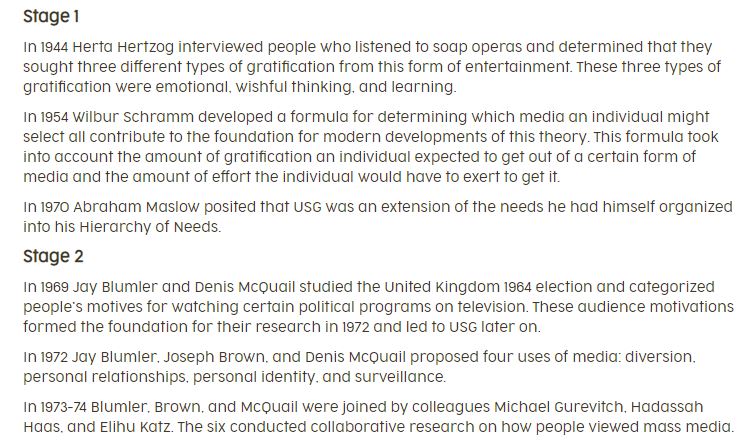
Stage one of the gratification theory was started by Herta Hertzog in 1944 were he interviewed people who listened to soap operas he found three different types of gratification from this which were emotional, wishful thinking and learning.
Stage two was made in 1969 by Jay Blumler and Denis Mcquail studied the United Kingdom 1964 election and categorized people’s motives for watching certain polotical programs on television. These audience motivations formed the foundation for their research in 1972 and led to USG later on.
In 1972 they proposed four uses of media which were diversionm, personal relationships, personal identity and surveillance.
Stage three states that UTG has more relevance than ever as a tool for understanding how we as individuals connect with the technologies around us. These technologies span everything from the internet to video gaming to mobile phones. From the research into mobile phones they have found out that people seek a number of gratifications from their phones inlcuding affection/ socialility, entertainment and mobility and there are lots more. It also states that people use social media because of factors such as the need to vent negative feelings, recognition and cognitive needs.
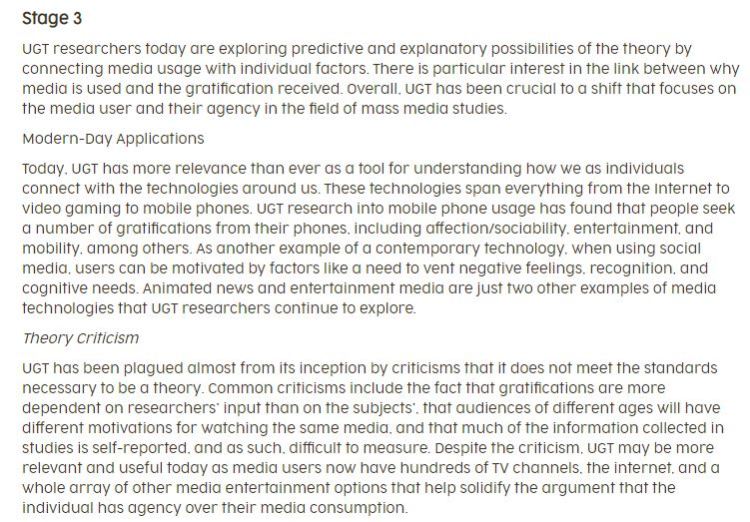
According to the last paragraph UGT has been plagued almost from its inception by criticisms that it does not meet standards necessary to be a theory. The common criticisms of it are that they are more dependant on the researchers input on the subjects, that the audiences of different ages will have will have different motivations for watching the same media.
For me the uses and grats theory does have an input into my videos as people will be watching my videos for motivation and to learn how to exercise and eat well, I know this because of my audience research here Primary Research on promotional videos because in the research a lot of my audience say that watching other people work out motivates them.
J. Lloyd, J. and McClung, S. (2016). Uses and Gratification Theory – Learning Theories. [online] Learning Theories. Available at: https://www.learning-theories.com/uses-and-gratification-theory.html [Accessed 5 Mar. 2020].
 JamieBlogs